

Renting a condominium in Pattaya is a popular option for expatriates, retirees, digital nomads, and long-term visitors, but understanding rental deposits is essential before signing a lease. A condo rental deposit is a refundable security payment that protects the landlord against unpaid rent, utility bills, or damage beyond normal wear and tear, while giving tenants the opportunity to recover the full amount if they meet their contractual obligations. In Pattaya, the standard arrangement is typically two months’ rent as a security deposit plus one month’s rent paid in advance, although the exact terms should always be specified in the lease agreement. This guide explains how condo rental deposits work, including common fees, refund procedures, tenant rights, landlord responsibilities, and practical tips for avoiding deposit disputes.
What Is a Condo Rental Deposit?
A condo rental deposit is a refundable financial guarantee that a tenant pays before moving into a rental property to protect the landlord against potential financial losses arising from unpaid obligations or damage caused during the tenancy. Unlike monthly rent, which pays for the right to occupy the property, the deposit remains the tenant’s money unless lawful deductions are necessary for unpaid rent, utility bills, missing items, or repairs beyond normal wear and tear. If the tenant complies with the lease agreement and returns the condominium in good condition, the remaining balance of the security deposit should generally be refunded after the final inspection and settlement of any outstanding charges.
Why Do Landlords Require a Security Deposit?
Security deposits have become a standard feature of residential leasing throughout Thailand because they reduce financial risk for property owners. Pattaya’s condominium market consists largely of privately owned investment properties that are rented fully furnished, often including expensive appliances, imported furniture, televisions, washing machines, kitchen equipment, and air conditioning units. Replacing or repairing these items can be costly, making a security deposit an important form of protection.
A landlord may use the deposit to cover expenses that arise if the tenant fails to comply with the lease agreement. These expenses commonly include unpaid rent, outstanding utility bills, repairs for damage beyond ordinary wear and tear, replacement of missing furniture or access cards, and other contractual obligations agreed upon by both parties.
From a broader perspective, the security deposit also benefits tenants because it encourages landlords to carefully document the property’s condition before move-in and establish clear expectations regarding maintenance responsibilities. When both parties understand the purpose of the deposit and maintain accurate records throughout the tenancy, disputes at the end of the lease are significantly less likely to occur.
Security Deposit vs Reservation Deposit
One of the most common areas of confusion for first-time renters in Pattaya is the difference between a reservation deposit and a security deposit. Although both involve an upfront payment, they serve entirely different purposes within the rental process.
A reservation deposit is typically paid before the lease agreement is signed in order to reserve a particular condominium. Once the landlord accepts the reservation, the property is usually removed from the market, preventing other prospective tenants from renting it. Because the landlord may lose potential rental opportunities during this period, reservation deposits are frequently non-refundable if the prospective tenant later decides not to proceed with the lease without a valid contractual reason. In many cases, however, the reservation deposit is credited toward the security deposit once the tenancy officially begins.
A security deposit, on the other hand, becomes effective only after the lease agreement has been executed. Its purpose is not to reserve the property but to provide financial security throughout the rental period. Provided that the tenant complies with the lease terms and returns the condominium in acceptable condition, this deposit is generally refundable after lawful deductions have been calculated.
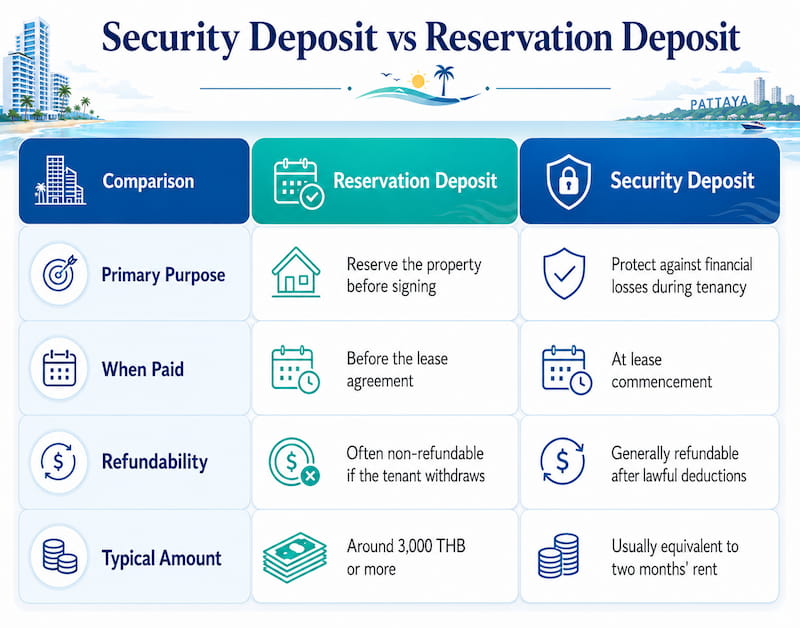
Because policies differ between landlords and property agencies, tenants should always request written confirmation explaining how any reservation payment will be treated if the rental does not proceed.
Typical Condo Rental Fees in Pattaya
Before moving into a condominium, tenants should prepare for several upfront costs in addition to the monthly rental payment. While the exact amount depends on the property’s location, quality, furnishings, and lease duration, Pattaya’s rental market follows a relatively consistent payment structure that most landlords and property agencies adopt.
For long-term rentals, tenants are commonly expected to pay two months’ rent as a refundable security deposit together with one month’s rent in advance. This means that before collecting the keys, a tenant will usually pay the equivalent of three months’ rent, although part of this amount represents refundable security rather than an actual rental expense.
For example, if a condominium rents for 20,000 THB per month, the tenant would typically pay 40,000 THB as a security deposit together with 20,000 THB for the first month’s rent, resulting in an initial payment of 60,000 THB before moving into the property. If a reservation deposit had previously been paid, it is often deducted from the total amount due at the time of signing the lease.
Beyond the deposit and advance rent, some condominium developments may charge additional fees depending on building policies and available facilities. These costs can include resident registration fees, parking permits, replacement fees for access cards, internet installation, or cleaning services arranged before move-in. Although these expenses are generally smaller than the security deposit itself, they should still be discussed in advance so tenants can prepare an accurate moving budget.
The prevalence of the two-month deposit reflects local market practice rather than a universal legal requirement. Since many condominiums in Pattaya are privately owned by individual investors, landlords rely on the deposit to reduce the financial risks associated with renting furnished properties that contain valuable household items.
Thai Laws Governing Condo Rental Deposits
Residential rental agreements in Thailand are primarily governed by the Thai Civil and Commercial Code, which establishes the contractual relationship between landlords and tenants. The law requires both parties to fulfill the obligations specified in their lease agreement while also recognizing general legal principles concerning property rights, contractual performance, and financial responsibilities.
In practical terms, this means that landlords are expected to provide a property that is suitable for occupation, while tenants are expected to pay rent, maintain the condominium responsibly, and comply with the conditions outlined in the contract. Because the lease agreement forms the legal foundation of the tenancy, every clause concerning deposits, maintenance responsibilities, refund procedures, and termination conditions should be reviewed carefully before signing.
In addition to the Civil and Commercial Code, Thailand has introduced consumer protection regulations that apply to certain landlords operating residential rental businesses. These rules were designed to reduce unfair contractual practices and improve transparency within the rental market. Under these regulations, landlords who fall within the scope of the law are generally prohibited from demanding excessive upfront payments and are expected to refund deposits promptly after the tenancy has ended, subject to any lawful deductions. The regulations also encourage greater transparency by requiring landlords to clearly explain deductions and comply with prescribed contractual standards.
It is important to recognize, however, that many condominiums in Pattaya are owned by individual investors rather than professional rental companies. As a result, while consumer protection legislation remains highly relevant, many rental arrangements continue to rely primarily on the specific terms negotiated within the lease agreement. For this reason, tenants should never assume that every landlord follows identical procedures and should instead ensure that all deposit-related terms are documented in writing before making any payment.
Rights and Responsibilities of Tenants and Landlords
A successful tenancy depends on both parties understanding not only their rights but also their ongoing responsibilities throughout the lease period. Many deposit disputes arise because expectations were never clearly established at the beginning of the tenancy rather than because either party intentionally acted unfairly.
Tenants are generally responsible for paying rent according to the agreed schedule, maintaining the property in a reasonable condition, reporting maintenance issues promptly, avoiding unauthorized alterations, and returning all furniture, appliances, keys, and access cards upon vacating the condominium. They are also expected to settle outstanding utility bills if these are their contractual responsibility.
Landlords, meanwhile, are responsible for providing accommodation that is suitable for residential use and ensuring that major fixtures and equipment supplied with the condominium remain functional unless damage has been caused by the tenant. They should also conduct deposit deductions fairly, communicate openly regarding any repair costs, and return the remaining balance of the deposit within the timeframe established by the lease agreement or applicable consumer protection regulations.
Although the lease agreement defines the legal relationship between landlord and tenant, maintaining detailed documentation throughout the tenancy often provides the strongest protection for both parties. Move-in photographs, signed inventories, payment receipts, maintenance records, and written communications can all become valuable evidence if disagreements later arise regarding the condition of the property or the amount of the deposit refund.
How the Deposit Refund Process Works
The refund process generally begins once the tenancy has ended and the tenant has formally returned possession of the condominium to the landlord. Although the precise procedure differs between individual landlords and property management companies, most follow a structured sequence designed to verify that all contractual obligations have been fulfilled before the deposit is released.
The process usually starts with a final inspection of the property. During this inspection, the landlord compares the current condition of the condominium with the inventory report and photographs prepared at the beginning of the tenancy. Furniture, appliances, walls, flooring, sanitary fixtures, and electrical equipment are examined to determine whether any damage exceeds what would normally be expected through everyday use.
Following the inspection, outstanding utility charges are calculated. Electricity and water invoices sometimes arrive after the tenant has vacated the property, meaning landlords may need to wait for the final bills before determining the exact refund amount. If the lease agreement permits this arrangement, part of the deposit may be temporarily retained until the outstanding utility costs have been confirmed.
Once any unpaid obligations have been identified, the landlord calculates any lawful deductions before returning the remaining balance of the deposit. Where deductions are made, good practice is to provide an itemized explanation together with supporting invoices or repair estimates whenever possible. Transparent communication during this stage often prevents minor disagreements from developing into larger disputes.
What Can Landlords Legally Deduct from the Deposit?
One of the most important aspects of any rental agreement is understanding what costs may legitimately be deducted from the security deposit. Although landlords are entitled to recover financial losses directly resulting from a tenant’s failure to comply with the lease agreement, they are generally not entitled to charge tenants for the natural deterioration that occurs through normal occupation of the property.
Legitimate deductions commonly include unpaid rent, outstanding utility bills, replacement of missing furniture or access cards, repairs to appliances that were damaged through misuse, and restoration costs arising from tenant negligence. If the lease agreement specifically requires professional cleaning before the property is returned, these costs may also be deductible, provided that such provisions are clearly stated in the contract.
The distinction between normal wear and tear and tenant-caused damage is particularly important because it forms the basis of many deposit disputes. Everyday use inevitably results in minor cosmetic changes such as slight paint fading, small scuff marks on flooring, or gradual aging of furniture and mattresses. These changes are generally considered part of the normal lifecycle of a furnished property and are not usually chargeable to the tenant. Conversely, broken windows, large holes in walls, extensive water damage caused by negligence, missing furniture, or deliberately damaged appliances represent losses that landlords may reasonably recover from the deposit.
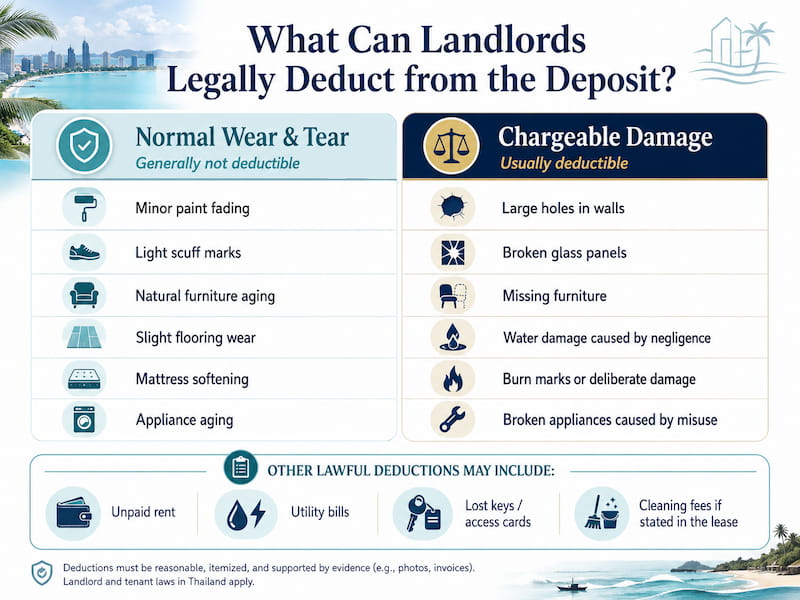
A useful way to understand this distinction is to compare it with renting a vehicle. Returning a car with slightly worn tires after normal driving would rarely result in additional charges, whereas returning it with a cracked windshield or collision damage would almost certainly require compensation. Residential rental deposits operate according to the same underlying principle: tenants are expected to return the property in good condition while landlords accept the gradual effects of ordinary everyday use.
Common Condo Rental Deposit Disputes in Pattaya
Although most tenancies end without major issues, deposit disputes remain one of the most common sources of conflict between landlords and tenants in Pattaya. Disagreements typically arise when expectations regarding property condition, maintenance responsibilities, or refund procedures are not clearly established before the tenancy begins. Many disputes can be avoided by having a detailed lease agreement, conducting thorough inspections at both move-in and move-out, and maintaining clear communication throughout the rental period.
Most Common Reasons Deposits Are Withheld
Landlords may retain part or all of a security deposit for legitimate contractual reasons, but disputes often occur when tenants believe the deductions are excessive or unsupported. The most common reasons include:
- Unpaid rent or utility bills
- Damage beyond normal wear and tear
- Missing furniture or household items
- Lost keys or access cards
- Excessive cleaning costs where permitted by the lease
- Early termination of the tenancy without following the contract
Whenever deductions are made, tenants should request an itemized breakdown together with receipts or repair quotations where appropriate. Transparent documentation helps both parties understand how the final refund amount was calculated.
How to Protect Your Rental Deposit
The easiest way to receive a full deposit refund is to document the property’s condition before moving in and maintain good records throughout the tenancy. While legal protections exist, strong evidence is often the most effective way to resolve disagreements quickly and fairly.
Before moving into the condominium, tenants should complete the following:
- Inspect every room carefully.
- Take dated photographs and videos of walls, floors, furniture, and appliances.
- Record electricity and water meter readings.
- Check that all listed furniture and equipment are present.
- Sign an inventory checklist with the landlord or agent.
- Keep copies of the lease agreement and payment receipts.
During the tenancy, it is equally important to report maintenance problems promptly, avoid making unauthorized alterations, and retain records of any repairs or communications with the landlord.
Before moving out, tenants should clean the property, repair any minor damage they are responsible for, settle outstanding utility bills where possible, and participate in the final inspection with the landlord. Completing these simple steps significantly reduces the likelihood of unnecessary deductions.
Move-In and Move-Out Checklist
A structured inspection process protects both landlords and tenants by creating a clear record of the property’s condition throughout the lease.
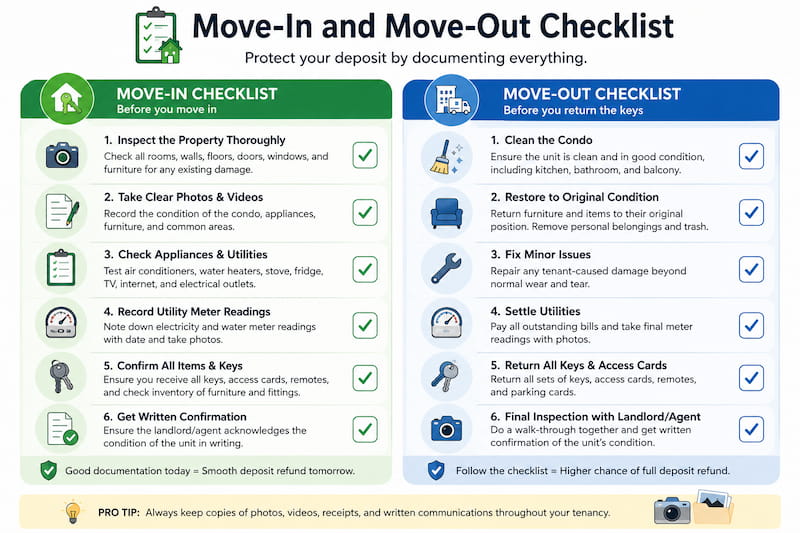
Following a checklist like this provides valuable evidence should any disagreement arise after the tenancy ends.
What to Do If Your Deposit Is Not Returned
If a landlord refuses to return the security deposit without a valid reason, tenants should first attempt to resolve the matter through open communication. Many disputes result from misunderstandings over repair costs or pending utility bills and can often be settled without formal legal action.
If negotiations are unsuccessful, tenants should gather all supporting evidence, including the lease agreement, payment receipts, inventory reports, photographs, videos, and written correspondence. These documents can help demonstrate the property’s condition and support any challenge to unreasonable deductions. Where necessary, tenants may seek advice from a legal professional or contact the relevant consumer protection authorities if the landlord falls within the scope of Thailand’s consumer protection regulations.
Example Deposit Refund Calculation
Understanding how deductions are calculated helps tenants know what to expect when moving out.
Assume a condominium rents for 20,000 THB per month, with a security deposit of 40,000 THB.
| Item | Amount (THB) |
| Security Deposit Paid | 40,000 |
| Outstanding Electricity Bill | -1,800 |
| Water Bill | -400 |
| Replacement Access Card | -800 |
| Wall Repair | -2,000 |
| Deposit Refunded | 35,000 |
In this example, the deductions relate to legitimate expenses arising from the tenancy, while the remaining balance is refunded to the tenant.
Frequently Asked Questions
How much is a typical condo rental deposit in Pattaya?
Most long-term rentals require a security deposit equal to two months’ rent, together with one month’s rent paid in advance. However, the exact amount depends on the landlord and the terms of the lease agreement.
Is a condo rental deposit refundable?
Yes. A security deposit is generally refundable after the tenancy ends, provided the tenant has complied with the lease agreement and any lawful deductions have been made for outstanding obligations or damage beyond normal wear and tear.
Can a landlord deduct cleaning fees?
Cleaning fees may be deducted if they are specifically stated in the lease agreement or if the property is returned in an unusually dirty condition that requires professional cleaning.
What is considered normal wear and tear?
Normal wear and tear includes minor paint fading, light scuff marks, gradual furniture aging, and other changes that occur through ordinary use of the property. These are generally the landlord’s responsibility rather than the tenant’s.
Can a landlord charge for repainting?
Repainting may only be justified if the tenant has caused damage beyond ordinary use, such as large holes, stains, or unauthorized painting. Routine repainting due to age is generally considered normal maintenance.
What happens if I end my lease early?
Early termination may result in the loss of part or all of the security deposit if the lease agreement specifies financial penalties. Tenants should review the contract carefully before ending the tenancy prematurely.
Can I negotiate the security deposit?
In some cases, yes. Individual landlords may agree to lower deposits for longer leases, tenants with strong references, or higher advance rental payments, although this is not guaranteed.
Should I attend the final inspection?
Yes. Being present during the final inspection allows both parties to discuss any concerns immediately and reduces the likelihood of disputes over the property’s condition.
What documents should I keep?
Tenants should retain copies of the signed lease agreement, payment receipts, inventory checklists, photographs, videos, utility records, and all written communication with the landlord or property agent.
How long should it take to receive my deposit?
The refund period depends on the lease agreement and the time needed to settle outstanding utility bills. Where consumer protection regulations apply, landlords are generally expected to return deposits promptly after inspection or within the prescribed timeframe if further verification is required.
Best Practices for Landlords and Tenants
Maintaining a positive landlord-tenant relationship depends on clear communication, a well-written lease agreement, detailed property inspections, and thorough documentation throughout the tenancy. By keeping an inventory, taking move-in and move-out photos, and retaining payment records, both parties can minimize disputes and ensure a transparent deposit refund process. For those planning to settle in Pattaya long term, exploring Pattaya Condos for Sale with Pattaya Prestige Properties can be a worthwhile alternative to renting, offering greater stability and the opportunity to invest in one of Thailand’s most sought-after property markets.
Conclusion
Condo rental deposits are a standard part of renting property in Pattaya and provide financial protection for both landlords and tenants when managed fairly and transparently. While the typical arrangement is two months’ rent as a refundable security deposit plus one month’s rent in advance, the specific terms governing refunds and deductions should always be clearly outlined in the lease agreement. By understanding Thai rental practices, documenting the property’s condition, keeping accurate records, and participating in thorough move-in and move-out inspections, tenants can significantly reduce the risk of deposit disputes and improve their chances of receiving a full refund at the end of the tenancy.