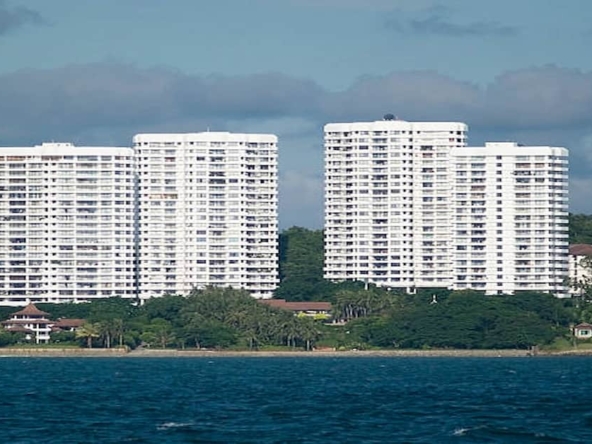

Choosing between a furnished and an unfurnished condo is one of the first decisions every renter faces when moving to Pattaya. Although both options provide the same fundamental purpose, a place to live, they differ significantly in monthly rental costs, upfront expenses, flexibility, convenience, and long-term value. The best choice depends on factors such as your budget, expected length of stay, lifestyle, and whether you prioritize immediate move-in convenience or long-term cost savings.
Pattaya’s condominium rental market is distinct from many residential markets around the world. As one of Thailand’s most popular destinations for expatriates, retirees, digital nomads, and international professionals, the city has developed a rental market where fully furnished condominiums dominate the available inventory. While unfurnished units remain available, particularly for long-term residents, they represent a much smaller portion of listings compared to turnkey properties designed for immediate occupancy.
This guide explains the differences between furnished and unfurnished condos, compares their costs and advantages, examines Pattaya’s rental market, introduces the concept of Total Cost of Occupancy (TCO), and helps you determine which option best suits your individual circumstances.
What Is a Furnished Condo?
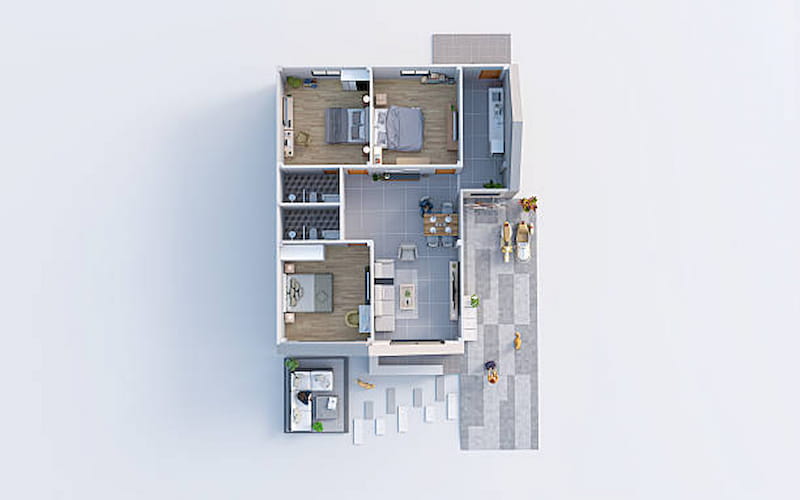
A furnished condo is a rental property that includes the furniture, appliances, and household essentials required for comfortable day-to-day living. Instead of moving into an empty apartment, tenants can typically begin living in the property immediately after collecting the keys, making furnished accommodation particularly attractive for people relocating from overseas or those seeking temporary housing.
In Pattaya, the majority of condominium rentals are advertised as fully furnished because many tenants arrive without personal belongings beyond their luggage. Property investors also prefer furnishing their units because move-in-ready properties appeal to a broader range of prospective renters, helping reduce vacancy periods and making the property more competitive in the local rental market.
Although furnished condos usually command higher monthly rents, they often eliminate thousands of baht in upfront expenses that would otherwise be required to purchase furniture and appliances.
What Is Typically Included in a Furnished Condo?
There is no universal standard for what constitutes a “fully furnished” condominium, so the contents can vary between landlords and developments. However, most furnished condos in Pattaya commonly include:
- Bed frame and mattress
- Wardrobe
- Sofa
- Coffee table
- Dining table and chairs
- Curtains or blinds
- Air conditioning units
- Refrigerator
- Microwave
- Television
- Washing machine
- Water heater
- Built-in kitchen cabinets
- Basic kitchen appliances
Higher-end condominiums may additionally include:
- Premium mattresses
- Decorative furniture
- Smart televisions
- Balcony furniture
- Built-in storage systems
- Coffee machines
- Kitchenware and cookware
- Interior décor
Because furnishing packages differ considerably, tenants should request a written inventory list before signing a lease. Photographing every room during the move-in inspection also helps prevent disputes over missing or damaged items when the tenancy ends.
Advantages of Renting a Furnished Condo
The biggest advantage of a furnished condo is convenience. Tenants can relocate without purchasing furniture, arranging deliveries, or spending time setting up an entirely new home.
Additional benefits include:
- Immediate move-in
- Lower upfront financial commitment
- No furniture shopping required
- Ideal for international relocations
- Easier temporary accommodation
- Reduced moving logistics
- No need to resell furniture before leaving Pattaya
These advantages explain why furnished condos are particularly popular among expatriates, retirees, digital nomads, and corporate employees who may only intend to remain in Pattaya for several months or a few years.
Disadvantages of Renting a Furnished Condo
Convenience comes at a cost. Since landlords recover the expense of purchasing furniture through rental income, furnished condos generally have higher monthly rents than comparable unfurnished properties.
Other disadvantages include:
- Higher recurring rental payments
- Limited freedom to personalize the interior
- Responsibility for accidental furniture damage
- Potential deductions from the security deposit
- Older furniture in some resale condominiums
Before signing a lease, tenants should clarify which repairs remain the landlord’s responsibility and which damages may be deducted from their deposit.
What Is an Unfurnished Condo?

An unfurnished condo is a rental property that provides the physical living space but includes few, if any, movable furnishings. While permanent fixtures such as built-in cabinets, bathroom fittings, lighting, and air-conditioning units are usually installed, tenants are generally expected to supply their own beds, sofas, dining furniture, appliances, and household accessories.
Although unfurnished condos are less common in Pattaya than fully furnished units, they remain an attractive option for renters planning to establish a long-term residence. Instead of paying a premium for furniture included in the monthly rent, tenants invest in furnishings that better match their personal preferences and can often reduce their overall housing costs over several years.
For many permanent residents, an unfurnished condo offers greater flexibility because they are free to choose furniture that suits their lifestyle rather than adapting to whatever has been provided by the landlord.
What Is Typically Included in an Unfurnished Condo?
The term “unfurnished” can vary between landlords, but most units include only permanent fixtures such as:
- Built-in kitchen cabinets
- Bathroom fixtures
- Air-conditioning units
- Water heater
- Ceiling lights
- Electrical outlets
- Fixed wardrobes (occasionally)
- Curtains (sometimes)
Tenants are usually responsible for providing:
- Bed and mattress
- Sofa
- Dining furniture
- Refrigerator
- Television
- Washing machine
- Kitchen appliances
- Storage furniture
- Home accessories
Because definitions differ, it is important to verify exactly what is included before agreeing to a tenancy.
Advantages of Renting an Unfurnished Condo
The principal advantage of an unfurnished condo is its long-term financial efficiency. Monthly rental rates are generally lower because landlords are not recovering the cost of furniture and appliances through rental income.
Other benefits include:
- Lower monthly rent
- Greater freedom to customize the interior
- Choice of furniture quality and style
- Better suited for permanent relocation
- No concerns about damaging landlord-owned furniture
- Ability to reuse furniture if moving locally
For families and long-term expatriates, creating a home that reflects their own preferences often outweighs the inconvenience of furnishing the property themselves.
Disadvantages of Renting an Unfurnished Condo
While monthly rental costs are lower, unfurnished condos require a significantly higher upfront investment.
Potential drawbacks include:
- Furniture purchases
- Appliance purchases
- Delivery costs
- Assembly costs
- Longer move-in process
- Future furniture maintenance
- Potential resale losses when relocating
For renters staying only six to twelve months, these expenses may exceed any savings achieved through lower monthly rent.
Fully Furnished vs Partially Furnished vs Unfurnished Condos
Not every rental property falls neatly into either “furnished” or “unfurnished.” Many landlords in Pattaya advertise units as partially furnished, creating a middle ground between complete convenience and full customization.
Understanding these categories helps renters compare properties more accurately and avoid unexpected furniture purchases after moving in.
| Feature | Fully Furnished | Partially Furnished | Unfurnished |
| Bed | ✔ | Usually | ✖ |
| Sofa | ✔ | Sometimes | ✖ |
| Dining Table | ✔ | Sometimes | ✖ |
| Refrigerator | ✔ | Usually | Sometimes |
| Washing Machine | ✔ | Sometimes | ✖ |
| Television | ✔ | Sometimes | ✖ |
| Kitchen Equipment | Usually | Limited | ✖ |
| Move-in Ready | ✔ | Mostly | ✖ |
| Monthly Rent | Highest | Moderate | Lowest |
| Upfront Setup Cost | Lowest | Moderate | Highest |
| Best For | Short-term renters | Mid-term renters | Long-term residents |
A partially furnished condo can be an effective compromise for renters planning to stay between one and three years. It reduces initial furnishing costs while still allowing tenants to personalize parts of their living space.
Furnished vs Unfurnished Condo Comparison
Although furnishing is the most obvious distinction, the decision affects many aspects of renting beyond the furniture itself. Monthly expenses, relocation costs, flexibility, maintenance responsibilities, and long-term affordability should all be considered before choosing a property.
The following comparison summarizes the key differences.
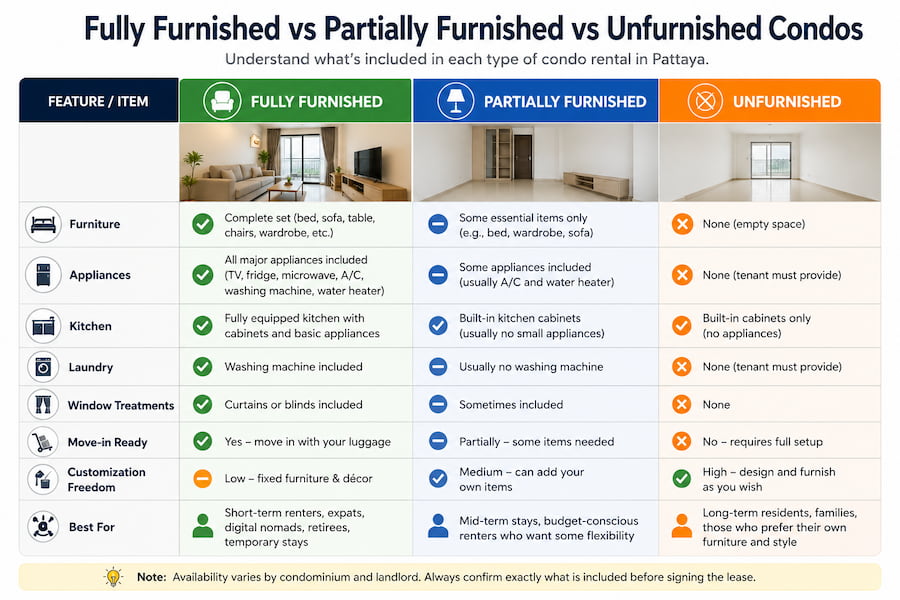
Rather than asking which option is objectively better, renters should evaluate which aligns more closely with their expected lease duration and financial priorities.
Cost Comparison: Furnished vs Unfurnished Condos in Pattaya
Monthly rent is often the first figure tenants compare, but it rarely reflects the full financial commitment of renting a property. A furnished condo may appear more expensive at first glance, while an unfurnished unit may seem more affordable. In reality, the true cost depends on how long the tenant intends to stay and the additional expenses incurred before and during occupancy.
For example, imagine two similar one-bedroom condos in the same Pattaya neighbourhood:
| Expense Category | Furnished Condo | Unfurnished Condo |
| Monthly Rent | Higher | Lower |
| Furniture Purchase | None | High |
| Appliance Purchase | None | Medium–High |
| Moving Costs | Lower | Higher |
| Interior Decoration | Minimal | Optional |
| Furniture Maintenance | Limited | Tenant Responsibility |
In the first year, a furnished condo often proves more economical because the tenant avoids major setup costs. Over several years, however, the lower monthly rent of an unfurnished property may gradually outweigh the initial investment required to furnish the home.
The key takeaway is that monthly rent alone should never be the sole basis for comparison. The total financial commitment over the intended lease period provides a much clearer picture of overall value.
Understanding the Total Cost of Occupancy (TCO)
Many renters make the mistake of comparing properties solely by their advertised rental prices. A more accurate approach is to evaluate the Total Cost of Occupancy (TCO)—the complete financial cost of living in a property throughout the lease.
This concept, widely used in business and investment analysis, provides a more realistic assessment of housing affordability by accounting for both recurring and one-time expenses.
Components of Total Cost of Occupancy
When comparing furnished and unfurnished condos, TCO should include:
- Monthly rent
- Security deposit
- Furniture purchases
- Appliance purchases
- Utility setup fees
- Electricity and water charges
- Internet installation
- Moving expenses
- Cleaning costs
- Furniture maintenance
- Replacement costs
- Potential resale losses
A simplified way to think about TCO is:
Total Cost of Occupancy = Rent + Setup Costs + Living Expenses + Maintenance Costs − Any Recoverable Value
For example, a furnished condo may carry a higher monthly rent but eliminate almost all setup expenses, making it the more economical option for a tenant staying only six months. By contrast, someone planning to remain in Pattaya for five years may recover the cost of purchasing furniture through years of lower rental payments, resulting in a lower overall cost of occupancy.
Evaluating rental options through the lens of TCO encourages better financial decision-making than simply comparing monthly rental rates.
Pattaya’s Rental Market: Why Furnished Condos Dominate
Unlike many residential markets in Europe, North America, or Australia, where unfurnished rentals are often the standard, Pattaya’s condominium market is overwhelmingly oriented toward furnished accommodation. This reflects both the city’s tourism-driven economy and the profile of its typical renters.
Pattaya attracts a diverse mix of expatriates, retirees, remote workers, digital nomads, seasonal residents, and international professionals. Many of these individuals relocate without furniture and expect to move into a property immediately upon arrival. As a result, landlords frequently furnish their units to appeal to the widest possible tenant base and reduce vacancy periods.
The structure of Pattaya’s property market also contributes to this trend. Many condominiums are purchased by investors rather than owner-occupiers, and developers often sell units with optional furniture packages or built-in interiors that can be placed on the rental market immediately. This has created a large inventory of turnkey rental properties, particularly in popular areas such as Central Pattaya, Jomtien, Pratumnak, Wongamat, and Na Jomtien.
For renters, this means there is generally a broader selection of furnished condos across most price ranges. However, greater availability does not necessarily make furnished accommodation the best financial choice. The optimal decision still depends on factors such as lease duration, lifestyle, relocation plans, and total cost of occupancy—all of which will be explored in the second half of this guide.
Which Option Is Better for Different Types of Renters?
There is no universally “better” option when comparing furnished and unfurnished condos in Pattaya. The ideal choice depends on your intended lease duration, financial situation, lifestyle, relocation plans, and long-term housing goals. A furnished condo prioritizes convenience and immediate occupancy, whereas an unfurnished condo often provides better financial value over an extended period.
Rather than focusing solely on monthly rent, consider the total cost of living over your entire stay. A tenant planning to live in Pattaya for six months will have very different priorities from someone intending to settle in the city for five years. By matching your rental choice to your circumstances, you can avoid unnecessary costs while ensuring your accommodation supports your daily lifestyle.
Furnished Condos for Digital Nomads and Remote Workers
Digital nomads and remote professionals generally benefit most from furnished accommodation. Many relocate frequently between cities or countries and prefer housing that allows them to begin working immediately without the logistical challenges of purchasing furniture or arranging deliveries.
A furnished condo also provides greater flexibility when work opportunities or visa conditions change. Instead of selling furniture before moving elsewhere, tenants simply pack their personal belongings and relocate.
A furnished condo is usually recommended if you:
- Stay in Pattaya for less than one year.
- Frequently travel between countries.
- Work remotely.
- Value convenience over customization.
- Do not own household furniture.
Furnished Condos for Retirees
Many retirees relocating to Pattaya choose furnished condos because they simplify the transition into a new country. Rather than coordinating furniture purchases immediately after arrival, retirees can settle into a comfortable living environment while gradually becoming familiar with local neighborhoods and services.
For retirees considering purchasing property in the future, renting a furnished condo for the first year also provides an opportunity to explore different parts of Pattaya before making a long-term investment.
Unfurnished Condos for Families
Families generally place greater emphasis on comfort, personalization, and stability than temporary convenience.
Children often require additional furniture, storage solutions, study areas, or safety modifications that furnished condominiums may not provide. Purchasing furniture allows families to create a living environment tailored to their specific needs while avoiding concerns about damaging landlord-owned items.
For households expecting to remain in Pattaya for several years, the lower monthly rent can also offset the initial furnishing costs over time.
Unfurnished Condos for Long-Term Residents
Permanent residents and long-term expatriates often find unfurnished condos to be the more economical option.
Although furnishing an apartment requires a larger upfront investment, these costs are spread across many years of occupancy. Over time, lower monthly rent may generate significant savings compared with continuously paying a premium for furnished accommodation.
In addition, tenants retain complete control over:
- Furniture quality
- Interior design
- Storage solutions
- Appliance selection
- Future upgrades
For many long-term residents, creating a home that reflects their lifestyle becomes more valuable than the convenience of moving into a pre-furnished property.
Recommendation by Tenant Profile
The following table provides a practical summary of which option generally offers the best balance of cost, flexibility, and convenience.
| Tenant Profile | Recommended Option | Primary Reason |
| Digital Nomad | Furnished | Immediate move-in and mobility |
| Remote Worker | Furnished | Minimal setup required |
| Corporate Relocation | Furnished | Temporary accommodation |
| International Student | Furnished | Lower upfront expenses |
| Retiree | Furnished | Convenient relocation |
| Couple Relocating Permanently | Unfurnished | Long-term value |
| Family | Unfurnished | Greater personalization |
| Long-Term Expat | Unfurnished | Lower lifetime housing cost |
| Investor Renting Before Buying | Furnished Initially | Flexibility while exploring the market |
Although these recommendations apply to most situations, individual financial circumstances and lease duration should always take precedence over general guidelines.
Hidden Costs Many Renters Forget to Consider
One of the biggest mistakes tenants make is comparing properties based solely on their advertised monthly rent. In reality, several additional expenses influence the true cost of renting a condominium.
These hidden costs may seem relatively small individually, but together they can significantly increase the overall cost of occupancy.
Utility Charges
Utilities are rarely included in long-term condominium leases.
Before signing, confirm:
- Electricity rates
- Water charges
- Internet fees
- Cable television costs
- Common area service charges (where applicable)
Some landlords charge electricity above government rates, making utility costs substantially higher than expected.
Furniture Damage and Deposit Deductions
When renting a furnished condo, tenants are normally responsible for damage beyond reasonable wear and tear.
Examples include:
- Broken chairs
- Damaged sofas
- Stained mattresses
- Scratched tables
- Missing remote controls
- Cracked televisions
To reduce the risk of disputes:
- Photograph every room before moving in.
- Verify the written inventory.
- Report existing damage immediately.
- Keep copies of all correspondence with the landlord.
Maintenance Responsibilities
Not every repair is automatically covered by the landlord.
Clarify responsibility for:
- Air-conditioner servicing
- Appliance repairs
- Plumbing
- Water heaters
- Light fittings
- Pest control
- Window repairs
Understanding these responsibilities before signing the lease helps prevent misunderstandings later.
Furniture Depreciation
For tenants renting an unfurnished condo, furniture should be viewed as a depreciating asset rather than a permanent investment.
Furniture may eventually require:
- Repairs
- Cleaning
- Transportation
- Storage
- Replacement
- Resale at a lower value
These future costs should be included when calculating the Total Cost of Occupancy.
Common Mistakes When Renting a Condo in Pattaya
Many rental problems arise because tenants overlook important details before signing the contract rather than because they choose the wrong property.
Understanding these common mistakes can help reduce financial risk and improve the overall rental experience.
Choosing Based Only on Monthly Rent
The cheapest advertised rental is not necessarily the least expensive property over the course of your tenancy.
Instead, compare:
- Monthly rent
- Setup costs
- Utility charges
- Furniture expenses
- Maintenance obligations
- Transportation costs
- Security deposit requirements
Evaluating the complete financial picture produces a more accurate comparison.
Failing to Inspect the Furniture
Never assume all furniture and appliances are functioning properly.
Before accepting the property:
- Test every air conditioner.
- Check the refrigerator.
- Run the washing machine.
- Turn on the television.
- Inspect mattresses.
- Photograph existing scratches.
A thorough inspection protects both tenant and landlord.
Ignoring Lease Conditions
Many disputes arise because tenants fail to read the contract carefully.
Pay particular attention to:
- Lease duration
- Deposit refund conditions
- Early termination clauses
- Maintenance responsibilities
- Utility billing
- Pet policies
- Guest restrictions
Understanding these terms before signing is considerably easier than resolving disagreements later.
Misjudging Your Length of Stay
One of the most expensive mistakes is selecting the wrong furnishing option because of inaccurate planning.
For example:
- Buying furniture for a six-month stay often results in unnecessary expenditure.
- Paying higher rent for a furnished condo over five years may ultimately cost far more than purchasing furniture at the outset.
Estimating your expected lease duration as accurately as possible is one of the most important parts of choosing between furnished and unfurnished accommodation.
Decision Framework: How to Choose Between Furnished and Unfurnished Condos
Instead of relying on assumptions, evaluate your priorities using a structured decision framework.
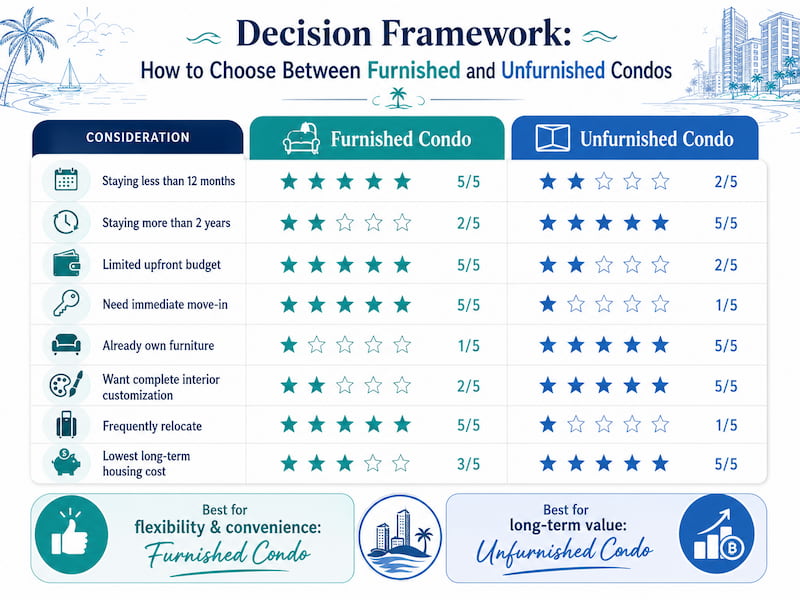
A practical way to use this framework is to score each criterion according to your personal priorities. The option that aligns with the majority of your requirements is likely to deliver the best overall value.
Condo Viewing Checklist Before Signing a Lease
Whether you choose a furnished or an unfurnished condo, conducting a systematic inspection before signing the lease can prevent unexpected expenses and disputes later.
Property Condition
Inspect the overall condition of the unit by checking:
- Walls and ceilings for cracks or water stains
- Flooring for scratches or loose tiles
- Doors, windows, and locks
- Signs of mould or water leakage
- Balcony drainage and railings
Furniture and Appliances
If the condo is furnished:
- Test every air-conditioner.
- Check the refrigerator temperature.
- Run the washing machine.
- Turn on the television.
- Inspect mattresses and upholstery.
- Confirm all listed furniture is present.
Utilities and Connectivity
Verify:
- Electricity meter readings
- Water meter readings
- Internet availability
- Mobile signal strength
- Number of electrical outlets
Building Facilities
Assess the quality of the condominium itself.
Check:
- Swimming pool
- Fitness centre
- Parking
- Security
- CCTV coverage
- Elevator condition
- Common area cleanliness
Lease Documentation
Before paying any deposit, ensure you receive:
- Written tenancy agreement
- Furniture inventory
- Deposit receipt
- Contact details for property management
- Emergency maintenance information
Conclusion
Ultimately, choosing between a furnished and an unfurnished condo in Pattaya depends on your budget, lifestyle, and expected length of stay. Furnished condos offer convenience and minimal upfront costs for short-term residents, while unfurnished units can provide better long-term value for those planning to settle down. By comparing the Total Cost of Occupancy, understanding your lease requirements, and carefully inspecting the property before signing, you can make a rental decision that best suits your needs.
If your stay in Pattaya is part of a longer-term relocation plan, it may also be worth exploring Pattaya Condos for Sale as an alternative to renting. Whether you’re searching for a rental today or considering property ownership in the future, Pattaya Prestige Properties offers expert guidance and a wide selection of condominiums to help you find the right property that matches your lifestyle and investment goals.
Frequently Asked Questions
Is a furnished condo always more expensive?
Generally, yes. Furnished condos usually command higher monthly rents because landlords recover the cost of furniture and appliances through rental income. However, for shorter stays, they may still be the more economical choice because tenants avoid significant setup expenses.
When does an unfurnished condo become more cost-effective?
There is no universal break-even point because the answer depends on rental prices, furnishing costs, and lease duration. In many cases, tenants planning to stay for two years or more begin to benefit financially from the lower monthly rent associated with unfurnished properties.
Are utility bills normally included?
Most long-term condominium rentals in Pattaya require tenants to pay electricity, water, internet, and other utility charges separately. Always verify the billing method and applicable rates before signing the lease.
Can rental prices be negotiated?
Yes. Many landlords are willing to negotiate, particularly for longer lease agreements, reliable tenants, or during periods of lower market demand. Offering a 12-month lease instead of six months may strengthen your negotiating position.
Should I buy furniture if I may relocate again?
If your future plans remain uncertain, renting a furnished condo generally offers greater flexibility. Purchasing furniture is usually more financially sensible when you expect to remain in the same property, or at least within Pattaya, for several years.